
From AI strategy and talent to standardisation and premium service delivery, here is what stood out at this year’s forum in Dublin.
There are conferences where you sit in a room, collect a tote bag, and leave with a stack of business cards and not much else. MSP Growth Forum Ireland 2026 was not that kind of event. We checked into St. Helen’s Hotel in Dublin last week in the company of some of the most candid, commercially sharp people in Ireland’s IT services sector and came back with the kind of thinking that does not fit neatly into a slide deck.
What follows are the themes that stuck. Not a polished summary of every session, but the ideas that challenged our thinking, the questions we are still sitting with, and the conversations that will shape how we show up for our clients in the months ahead.
Service is table stakes. Thought partnership is where the real work starts.
Ian Brown of Integrity360 opened the day with a fireside chat that set the tone for everything that followed. His central point was straightforward and a little uncomfortable: delivering a reliable service is no longer enough to differentiate an IT business in Ireland. The organisations pulling ahead are the ones that have genuinely embedded themselves in their customers’ growth strategy. Not responding when things go wrong, but actively shaping how their clients think about what comes next.
That distinction, between service provider and thought partner, is one worth sitting with regardless of what sector you are in.
On AI, Ian was unambiguous. If you do not have a clear position on how you are handling AI for yourself and your customers, you are already behind. Integrity360 has invested internally in both Claude and Microsoft Copilot, and his advice to the room was not complicated: encourage your team to use these tools rather than fear them. He also mentioned that Integrity360 is actively developing a service offering around Quantum Computing, which tells you something about how seriously they are taking the pace of what is coming.
His hiring philosophy was the kind of direct that tends to land. Hire nobody rather than the wrong person. In his experience, giving the benefit of the doubt on a hire has rarely worked out well. The cost of the wrong decision consistently outweighs the discomfort of a longer search.
If the culture stops at the leader, the leader is the bottleneck.
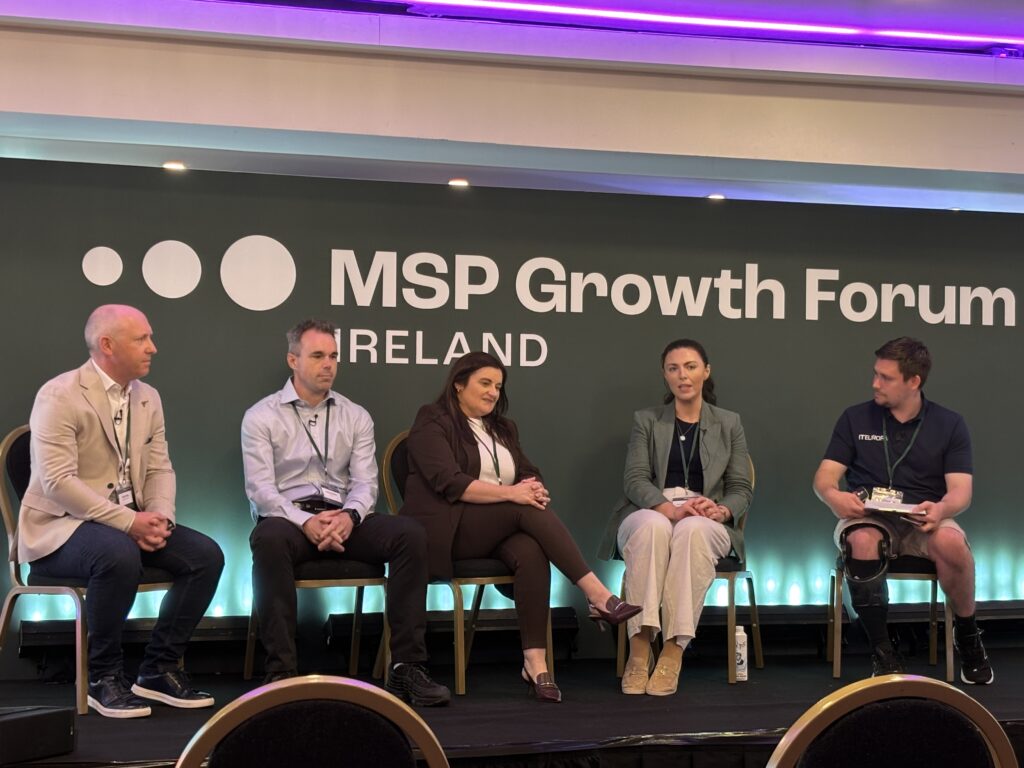
The first panel brought together Karen O’Connor from Datapac, Isobelle Coventry from Evergreen, Finian Nally from MicroWarehouse, and Melvyn White from Rewst. It was one of the most practically useful sessions of the day, partly because the panellists were willing to be specific rather than staying safely general.
The line that has stayed with us came from Melvyn White: if the culture stops at the leader, the leader is the bottleneck. It is a challenge that applies well beyond the MSP sector. Culture has to be built into the structure and rhythm of a business, not held together by a single person’s presence or energy. When that person is out of the room, what happens?
Finian Nally’s approach to growth was specific enough to be worth writing down. Find the one product or service you can sell to 90% of your customer base and standardise around it. Growth does not come from trying to be everything to every customer. It comes from being very good at something specific and building the systems to deliver it consistently. Karen O’Connor reinforced this from a positioning perspective: know what you do well, position yourself as the leader in that space, and resist the pull toward spreading yourself across every opportunity that comes along.
On talent, two things stood out. Evergreen’s view is that IT businesses are not competing with big tech for people. They should be attracting candidates who want broader scope, faster development, and more meaningful impact than a large enterprise can offer. Datapac has built its graduate programme specifically around demonstrating that advantage, and most of their senior roles are now filled by people who came through their own ranks. That is not luck. It is the result of a deliberate, sustained investment in developing people over time.
The live poll results from the room put hard numbers on what most people in the IT sector already sense. 79% of respondents named scaling sales capability as their biggest barrier to growth. 60% identified lack of standardisation as their most pressing operational challenge. 69% said sales and go-to-market expansion was the most critical area for the next two to three years. These are not abstract concerns. They are the everyday reality of most IT businesses trying to grow in Ireland right now.
Technology scales the business. But leadership has to come first.
The Evergreen boardroom session was one of the highlights of the day and delivered exactly what it set out to. The message was consistent with the broader theme running through the forum: tools and platforms can multiply the capacity of a well-led team. They cannot compensate for the absence of one. As part of the Pine Services Group and Evergreen family, this was a session with particular resonance for us. The philosophy Evergreen articulates around leadership, accountability, and long-term value creation is not something they talk about at events and leave there. It is the operating model we are part of.
Too many tools. Too little integration. Too much done by hand.
The afternoon panel with Alex Attwood from ConnectWise, Stephen Curtin from Huntress, and Gerard Cox from Intuity Technologies moved into the operational mechanics of building a business that can actually scale without breaking.
Tool sprawl came up repeatedly and it deserves to be named clearly. Too many disconnected systems do not just create inefficiency. They create inconsistency in the customer experience, increase risk, and make it genuinely difficult for people to do their best work. Reducing vendor and partner spread is not primarily a cost decision. It is a quality and consistency decision, and the two are more connected than most businesses acknowledge.
Gerard Cox made a point that is easier to agree with than to actually do: be intentional and deliberate. Make the decision and commit to it. Indecision and gradual drift cause as much damage to a growing business as a bad decision made quickly and owned fully. Possibly more, because at least a bad decision you own gives you something to learn from.
One observation from this session that felt genuinely forward-looking: human-to-human interaction is increasingly becoming a premium product. As automation handles more of the routine, the businesses that invest in real human expertise and genuine relationship quality will be able to charge accordingly for it. The question for every IT services business right now is whether they are actively building toward that premium position, or quietly drifting away from it.
Build what your customers actually need. Not what you want to sell.
The closing keynote from Garvan Callan of ONEZERO1 was the session that will stay with us longest. Garvan works with executives and leadership teams across Ireland, and his central argument was direct enough to be slightly uncomfortable: the biggest mistake IT and professional services businesses make is building around what they want to sell rather than what their customers actually need.
He used three examples to make the point concrete. Audi’s showroom model, where a concierge builds the car around what the customer describes rather than pushing from a catalogue. Netflix, which guides you toward what to watch next rather than presenting an overwhelming choice and leaving you to figure it out. And IKEA’s AR tool, which lets you place furniture in your own space before buying, turning what could be a transactional product decision into something that actually relates to your life. In each case the business has reoriented entirely around the customer’s real goal rather than its own product.
He used an iceberg analogy that landed quietly but powerfully. People only ever see your actions. But your actions are a direct reflection of how you think. The question for every business in that room was the same: what does your market presence say about how you actually think?
His closing challenge was the one that will keep coming back to us: how do you create a premium service with a reduced cost to serve? There is no neat answer to that question. But it is unquestionably the right question to be asking, and the businesses that take it seriously will look very different in five years to the ones that do not.
What We Are Taking Back to DB Computer Solutions
The most valuable thing about an event like MSP Growth Forum Ireland is not any single session or speaker. It is the clarity that comes from spending a day in a room with people who are navigating the same terrain, thinking seriously about the same challenges, and willing to be honest about what is working and what is not.
Several themes from the day align directly with the direction DB Computer Solutions is already moving in. Standardisation is something we are actively building into how we deliver and scale our services. AI positioning is a conversation we are already having with our customers, and one we are deepening as the technology matures and the questions become more specific. Thought leadership, specifically what our market presence communicates about how we think, is central to the marketing and content investment we are making right now. And the challenge of delivering a premium service experience at a lower cost to serve is one that sits at the heart of how we are developing our operational model.
These are not abstract strategic priorities for DB Computer Solutions. They are live workstreams. Events like MSP Growth Forum Ireland are useful precisely because they sharpen the thinking, surface new angles, and occasionally introduce an idea or a challenge that accelerates the work already underway.
If any of the themes covered in this post are relevant to your business and you would like to explore how DB Computer Solutions can support you, we would be glad to have that conversation.
–
DB Computer Solutions
Sage Business Partner | Limerick | Cork | Dublin
DB Computer Solutions is one of Ireland’s most experienced Sage Business Partners, working with Irish businesses across Sage 50, Sage 200, and Sage Intacct, alongside full IT Infrastructure, Hardware, and IT Support services. As part of the Pine Services Group and Evergreen family.
📩 paige@dbcomp.ie
🌐 dbcomp.ie
📍 Limerick | Cork | Dublin
For marketing enquiries, partnerships, or media requests contact paige@dbcomp.ie
MSP Growth Forum Ireland 2026, Irish IT services, managed services Ireland, MSP Ireland, IT business growth Ireland, AI for Irish businesses, Evergreen MSP, Pine Services Group, DB Computer Solutions, IT leadership Ireland, scaling MSP Ireland, standardisation IT services, cybersecurity Ireland SME, Irish technology leaders 2026